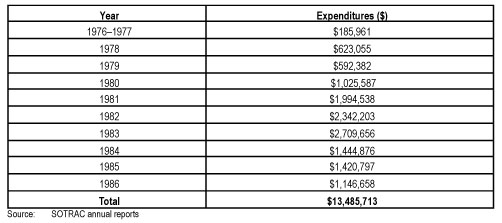
The Société des travaux de correction du Complexe La Grande (SOTRAC) was constituted with the signing of the James Bay and Northern Québec Agreement (JBNQA) in 1975. SOTRAC's mandate was to further assess the impacts of hydroelectric developments on the Cree way of life and to implement measures to mitigate them, particularly in terms of hunting, fishing and trapping.
SOTRAC was active from 1976 to 1986, when its mandate was transferred to the Eeyou Corporation under the La Grande (1986) Agreement. During its mandate, SOTRAC's expenditures amounted to $13.5 million.
During its mandate, SOTRAC carried out over 100 studies and projects in accordance with the list of eligible work and programs. Nearly half of these sums were spent on a limited number of large-scale projects, such as the construction of weirs on the Eastmain and Opinaca rivers, winter roads, boat hauling structures and float-plane bases at Eastmain, Wemindji and Chisasibi, channels along the James Bay coast north of the Grande Rivière and an access road to the coast at Chisasibi.
The remedial work carried out by SOTRAC created a number of jobs for the Crees. Generally temporary, many of these jobs were associated with contracts administered by the band councils for work performed on the traplines such as clearing snowmobile trails, developing ponds for goose hunting and building hunting camps. According to the SOTRAC annual report for 1984, these jobs represented 14,611 person-days between 1978 and 1984. Many Crees also worked for Cree and non-Cree companies mandated by SOTRAC to perform larger-scale infrastructure work. Lastly, during close to its entire mandate, SOTRAC's regular personnel included four Cree employees who represented the company in each of the villages of Chisasibi, Wemindji, Eastmain and Mistissini. |