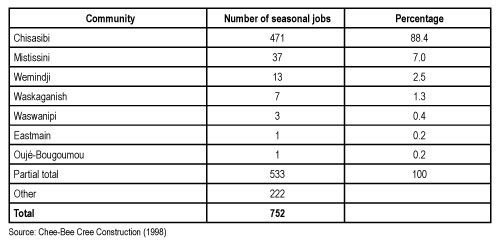
Under the Opimiscow Agreement (1992), a fund of $25 million was allotted to implement measures to reduce the impact of the Laforge-1 and Laforge-2 developments on hunting, fishing and trapping by the Crees. The measures were carried out by Opimiscow-SOTRAC, a mixed enterprise company involving HydroQuébec and the communities of Chisasibi and Wemindji.
The company was active from 1993 to 1998 and its expenditures totalled $24,932,410. The Chee-Bee Cree Construction company of Chisasibi benefited from 90% of this amount ($22,407,329). The work completed under the Opimiscow Agreement created 755 seasonal jobs, 533 of which were held by Cree workers. The community with by far the highest rate of participation in the work was Chisasibi, where 88% of the jobs were created.
With 70 person-days per job at a wage of $15 per hour, which is comparable to the wage paid by Cree entities, over $5.5 million in wages was paid to Cree workers.
The James Bay Eeyou Corporation, which was incorporated in 1986 to take over for SOTRAC, manages the funds allotted under the La Grande (1986) Agreement for mitigation measures and remedial work. The remedial work fund includes $15 million provided for under the La Grande (1986) Agreement, as well as $16.8 million remaining from SOTRAC.
Since 1987, about $2 million a year from the fund has been used to finance remedial work and programs to benefit the various Cree communities, particularly the trappers. |