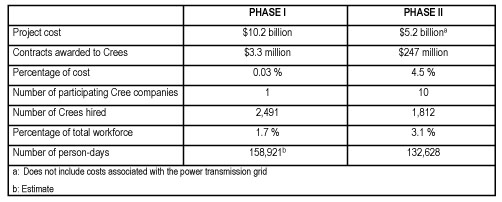
In the early 1970s, the Cree economy was largely dependent on traditional hunting, fishing and trapping, and there were few or no Cree businesses in the communities that could compete with the companies involved in carrying out Phase I of the La Grande complex. This lack of entrepreneurship resulted in very few contracts being awarded to Cree entities. However, a number of Cree workers did participate in the work, as is reflected in the partial data compiled by the Association des employeurs de la Baie-James.
The development of Phase II of the complex gave the Cree contractors and companies the opportunity to corner a large part of the market generated by the work (150 times more than in Phase I) thanks to the creation of several new companies, particularly in the service industry. The participation of Cree labour also increased to reach 4.5% of hires.
These new capabilities were then put to good use in providing a number of the services required to operate the facilities, including air transport, lodging for workers (housekeeping) and land transport. Signed in April 2004 the Agreement Concerning a New Relationship between Hydro-Québec/SEBJ and the Crees of Eeyou Istchee provides for a procedure to study the ability of Cree businesses to participate in La Grande complex operations, maintenance and repair contracts as well as to develop ways of increasing the participation of Cree businesses in such contracts.
However, the hiring of Cree workers on the Hydro-Québec teams handling facilities operations has remained marginal (about 2%), despite concerted efforts to rectify this at the beginning of the 1990s. The Cree Employment Agreement signed February 7, 2002 by Hydro-Québec and the James Bay Crees aims to improve the situation, as 150 Crees are expected to be employed in permanent positions in the James Bay region by March 2017.
|