By virtue of section 11.2 of the La Grande (1986) Agreement, Hydro-Québec agreed “…to take the necessary measures to hire and train the largest number possible of Cree for its operations in the James Bay area”. In this context, “…The objective of both parties to the agreement is, by 1996, to have 150 Cree beneficiaries of the JBNQA permanently employed within the La Grande complex”. In order to meet the objective, Hydro-Québec set up a hiring program called “Horizon 1986-1996” created along the lines of a Native manpower training program. Initially, it was intended that the program be based upon on-the-job training prior to being assigned a position at Hydro-Québec. The training program was supposed to be offered at the different generating stations operated by Hydro-Québec throughout the Complex. As the expected rate of student success was estimated to be around 50%, the training program was designed for a total of 300 candidates in 14 different types of jobs (Tremblay, 1992). To receive the training, the candidate needed to be a Cree beneficiary of the JBNQA.
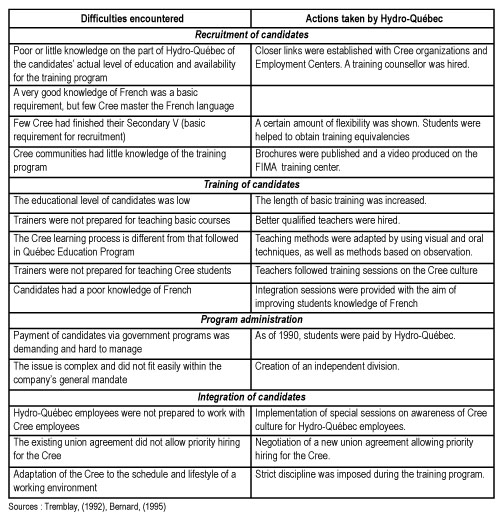
The first training activities organized along these lines by Hydro-Québec in 1986 encountered several difficulties. In January 1989, following an internal evaluation by Hydro-Québec, the Native training and hiring program took a new turn. It was decided to centralize all training activities at La Grande3 through the creation of a Native Manpower Training and Integration Center (FIMA). The range of job categories targeted in the training program was reduced and adapted to new corporate needs. From then on, students would be paid by Hydro-Québec and selected on the basis of job interviews carried out in all Cree communities.
In 1990, the FIMA training program at La Grande3 entered a new phase with the arrival of four new groups and the development of two new courses: Equipment mechanics and Office clerk. However, the FIMA training program continued to encounter several difficulties, including problems of administrative overlap among the various agencies concerned, until its completion in 1996.
When the FIMA program ended as planned in December 1995, 50 Cree students among the 85 who had enrolled between 1986 and 1995 had completed their courses. Of these 50 students, 20 were still employed by Hydro-Québec in 2000, including 10 equipment electricians, 8 equipment mechanics and 2 office clerks. Most of the 30 other Cree students were employed elsewhere. |