
Îles‑de‑la‑Madeleine: new generating station
- Region
- Gaspésie‑Îles-de-la-Madeleine
- Status
- Under study
- Type
- Production
- Expected commissioning
- 2035
To ensure the energy security of Îles‑de‑la‑Madeleine, Hydro‑Québec will build a new generating station on the archipelago by 2035.

On this page
Project description
The energy future of Îles‑de‑la‑Madeleine
The current generating station was built in the early 1990s and is reaching the end of its service life. The new generating station with greater capacity will be built on the same site, behind the existing facility, and will use low‑carbon intensity fuels. Hydro‑Québec wants to reduce GHG emissions in the archipelago and make this generating station a sustainable solution. There are also plans to make greater use of wind and solar energy and reduce electricity demand through energy efficiency programs. These measures will help ensure that the output of the new generating station is lower than that of the current facility, thereby reducing the fuel consumption required to supply energy to the Îles‑de‑la‑Madeleine.
From now until the commissioning of the new generating station, work will be carried out to ensure the reliability of the current station's supply.
What is a low‑carbon intensity fuel?
A low‑carbon intensity fuel is designed to reduce greenhouse gas emission, from production of the raw materials to the use of the final product. It mainly comes from non‑fossil sources such as vegetable oils, animal fats, or agricultural residues.
Take a closer look

Over the next few years, Hydro‑Québec will be undertaking major projects in Îles‑de‑la‑Madeleine, including the construction of a new generating station, the undergrounding of a transmission line and the implementation of energy efficiency measures across the archipelago. Learn more about the key milestones.
Video of 8 minutes
Draft‑design phase
The construction project is currently in the draft-design phase. Hydro‑Québec teams, in collaboration with external partners, are developing the design of the new generating station. Construction is slated to start in 2030. In the meantime, and prior to the commissioning of the new facility, a number of milestones must be reached.
The new station (80 to 100 MW) will be capable of generating more power than the current station (67 MW). Hydro‑Québec is currently analyzing two types of low‑carbon fuel for the new generating station: renewable liquefied natural gas and renewable diesel. These options offer the best potential in terms of deployment and performance in the medium term.
These two fuels, although renewable, have different carbon footprints depending on the complexity of their supply chain:
- Renewable liquefied natural gas (RLNG): The gas is first liquefied, then transported by sea and land in ISO containers (25 trucks per week on average over a year – 15 during the summer period and close to 40 during winter peak periods) to a storage and regasification area before being used as fuel in the power plant. Hydro‑Québec will assess the impacts associated with the processing and transportation of this fuel. See the RLNG supply chain illustrated [PDF 193 kB – in French only]
- Renewable diesel: The fuel arrives by tanker at the port, then is transferred directly into a pipeline that carries it to storage tanks before being used by the power plant. Hydro‑Québec will assess the impacts associated with the processing and transportation of this fuel. See the renewable diesel supply chain illustrated [PDF 113 kB – in French only]
The design of the future generating station will include an option to later switch to another type of renewable fuel, depending on how the market evolves.
Work will also be carried out around the generating station. Specifically, a new switchyard will be built within the boundaries of Hydro‑Québec's land in Cap‑aux‑Meules as part of the project to convert the transmission system's voltage.
Environmental process
As with all of its projects, Hydro‑Québec will carry out environmental studies. The project to build the new generating station will be subject to an environmental impact assessment and review, which could lead to the holding of public environmental hearings.
Hydro‑Québec is planning to start the environmental impact study for the project in the fall of 2025, to be submitted for governmental approvals as of mid‑June 2027.
Although the environmental assessment will analyze the project's impacts on a multitude of components in the human, natural and physical environments, the main environmental issues anticipated at present are as follows:
- Reducing greenhouse gas emissions related to supplying electricity across the islands
- Maintaining or improving air quality (contaminants, odours)
- Protecting the aquifer
- Preserving natural land, aquatic and coastal environments
- Sharing of spaces during the work (traffic, multi‑use path, sound emissions)
- Local economic benefits
Information and dialogue with the archipelago's population
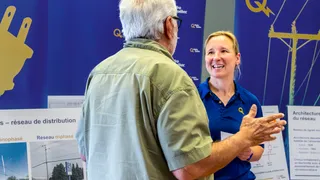
The Hydro‑Québec team met with the population of Îles‑de‑la‑Madeleine in 2025 to present and explain the various projects and measures that will define the archipelago's energy future.
Similar meetings will be held over the coming year. This will be an opportunity to answer questions and gather concerns and suggestions from residents.
Hydro‑Québec will keep the population informed of these events.

Send us your comments
Our teams are committed to working with the community to deliver this major project that will benefit residents of Îles-de-la-Madeleine.

Work schedule
-
2025‑2026
Analysis of environmental issues
-
2025‑2029
Draft‑design phase
Government approvals
Project optimization, selection of fuel
-
2030‑2034
Construction
-
2035
Commissioning
Let's design a project that blends harmoniously into its surroundings
Documentation
Contact us
We're committed to keeping the lines of communication open. Please send us your questions and comments about the project.
- Info‑Project line : 1 866 388‑1978
- affairesregionales@hydroquebec.com

Newsletter Îles-de-la-Madeleine new generating station
Stay up to date on the project stages and progress to date.