The lighting section in most hardware stores contains an endless array of light fixtures, LED bulbs, dimmers and other accessories. You could spend an entire Saturday afternoon just trying to sort through it all! Whether you want lighting for your kitchen, a reading nook or artwork, our guide outlines the key criteria to consider before you make your purchase.
Bulbs: What you should check before buying
Once you are in front of the display, look for these things to ensure you choose the right bulb for your needs.
Lumens
Lumens refer to the amount of light produced. A higher number indicates a more intense light.
What about Watts? Watts are no longer used to measure brightness. Instead, they indicate the amount of electricity used.
Colour temperature
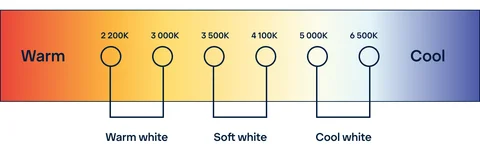
Expressed in kelvins (K), the colour temperature refers to the light’s appearance.
Lower numbers produce a warm, yellowish glow, whereas higher numbers produce a cool, blue‑white light.
Colour‑rendering index (CRI)
The colour‑rendering index (CRI) indicates how accurately the light brings out colour. The higher the index, the more natural colours will appear. For most residential uses, a CRI of 80 to 90 indicates that colour will be revealed in a comfortable and natural way. This corresponds to most LED bulbs and light fixtures. A CRI of 90 or more can be appropriate in rooms where colour is more important—such as the kitchen or the bathroom—or where you do your make‑up, select your clothing or carry out manual work.
Format
LED bulbs are not interchangeable, so before you buy them, check the type of base and the shape of the bulb. The E26 bulb base is the most common base in North America for screw‑in light bulbs, and A15 and A19 formats refer to classic, pear‑shaped light bulbs.
However, some light fixtures require a specific format, such as GU10 bulbs for spotlights or adjustable recessed light fixtures, or BR30 light bulbs for certain recessed ceiling lights. It you’re not sure, take the bulb to the store or check the information on your light fixture.
Dimmer compatibility
If you want to use a dimmer to adjust the intensity of the light, opt for a dimmable bulb that is compatible with your dimmer.
When a bulb is not compatible with a dimmer, you may notice flickering, buzzing or a bulb malfunction.

Good to know
If your dimmer is from the time when incandescent and halogen bulbs were popular, it may not be compatible with LED bulbs. You may need to replace it with a model designed for an LED bulb.
Lifespan and warranty
You should also compare the declared lifespan with the manufacturer’s warranty. This information may help you decide between otherwise similar products.
Why has LED lighting become the norm?
Incandescent, halogen and compact fluorescent bulbs have been slowly disappearing from stores in recent years. If LED bulbs have become the norm, it’s primarily because less energy‑efficient products have been gradually withdrawn from the market. However, it is mainly due to their many advantages that they are now the top choice in our homes:
- LED bulbs consume on average 70% to 90% less electricity than incandescent models.
- They last at least 15 times longer than traditional models.
- They produce very little heat.
- They are available in an impressive array of formats and intensity levels.
Little extras that simplify your life
In addition to light bulbs, there are several accessories that help improve comfort and reduce electricity use.
Timers and motion sensors
These devices turn a light on when needed and are particularly useful in the following spaces:
- Outside
- In an entryway
- In a garage
- In low‑traffic areas
Smart lighting
Smart light bulbs, switches and dimmers help you adjust your lighting remotely from a mobile device.
Depending on the model, you can create schedules, make certain adjustments automatically, modify the colour or intensity of the light or use a voice assistant to adjust your lighting.
Good to know
Features vary from one product to another. Before purchasing a product, always verify its compatibility with your smart systems.
Informed choices made easy
You now have what you need to make sense of the lighting aisle. The best part? You don’t need to choose between ambience and energy savings. Thanks to today’s technologies, you can create your ideal lighting and also use less electricity. You get the best of both worlds!