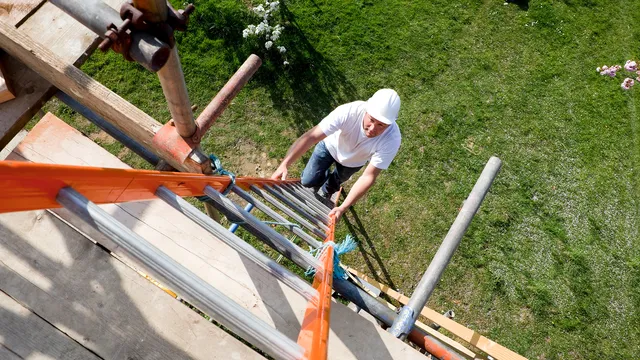
Safety during work
Before you begin, determine whether overhead or underground power lines are liable to pose any hazards. Here's how to ensure your safety and that of others by taking the proper precautions.

Work near overhead power lines
It is essential to observe safety clearances and avoid any contact with or dangerous proximity to power lines.
Precautions to take near power lines

Assess the environment
Identify any power lines around you and assess the risks based on the required safety clearances.

Stay at least 3 m away from any power lines
Always maintain a distance of at least 3 m (10 ft.) between power lines and yourself, your tools and your equipment.

Use non-conductive materials
Choose composite or fiberglass tools and equipment, and wear the appropriate protective gear.

Use long-reach tools and equipment with caution
Move slowly and have someone monitor your movements until the work is completed.
Safety notice
To assess distances, never bring anything close to power lines:
not tape measures, not tools, nothing. Instead, estimate distances visually from ground level.
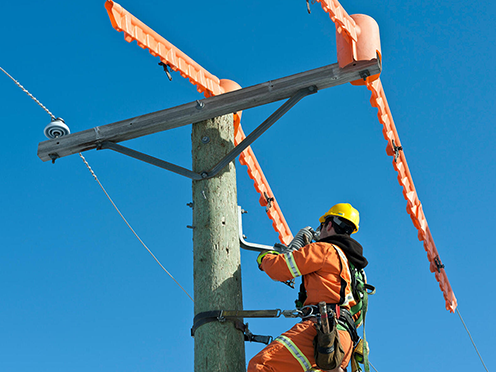
Struggling to maintain the 3-m clearance?
Learn about your responsibilities, Hydro‑Québec's safety measures and key resources for carrying out work safely.
Working near buried infrastructures
Before you dig, identify any underground networks by placing a locate request with Info-Excavation. It's easy and costs nothing. To find out how to work safely, read the guidelines.
Precautions to take when digging

Never assume the depth of buried utility lines
Even small-scale work can affect underground infrastructures. Always follow the official Info-Excavation guidelines.

Stay within the markings
Only dig within marked areas to avoid damaging utility lines.

Keep the work area under supervision
Monitor the site while work is ongoing, and stop immediately in the event of doubts or irregularities.
Do not dig within 1.5 m of a pole or guy wire
Digging too close to a support structure or an anchoring system can compromise power system infrastructure. If it is absolutely impossible for you to comply with this distance, a temporary support system, verified and approved by Hydro‑Québec, must be installed to prevent the support structure from falling.
Before starting any outdoor work, it's important to identify any hazards. Learn how to work in complete safety.

It's important to identify any hazards prior to starting your outdoor work. Learn how to work in complete safety.
1-minute video
Risks during work
There may be electrical, telecommunications or cable lines in the work area; there may also be visible or buried natural gas and sewer pipes. Any contact with, or damage to these can have serious consequences.
Serious injury or death
Working near overhead or underground power lines without heeding the safety rules can lead to serious accidents. Possible consequences include severe burns, internal injuries and death. The risk is higher in wet environments or when using conductive materials.
To find out more, read our article Electric shock: Understanding how to stay safe.
Service outages
When a cable or pipe is damaged, electricity, gas, water or telecommunications services may be disrupted. These outages can affect safety, everyday life and business operations. They may also require an emergency response and impact neighbours and local businesses.
Significant costs
Damage to underground or overhead infrastructures can result in significant repair and compliance restoration costs. It can also delay projects and lead to contract penalties and financial losses for the affected individuals or businesses.
Environmental impacts
A damaged pipe or punctured tank can release chemicals, gas or wastewater. These substances can pollute the soil, contaminate water, harm plants and animals and, in some cases, cause a fire or an explosion. What's more, repairs can be lengthy and costly.