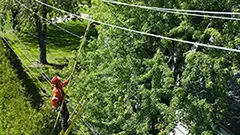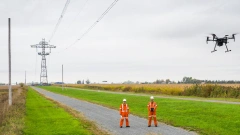


If you enjoy the trees and green spaces in your neighbourhood, it’s natural to wonder why branches and trees near power lines are sometimes trimmed. These interventions are necessary to ensure grid reliability and everyone’s safety.
Vegetation: The leading cause of power outages
Every year, a significant number of power outages are caused by vegetation. When you think about it, it’s easy to see why: the distribution system covers thousands of kilometres of wooded areas, in both urban and rural settings.
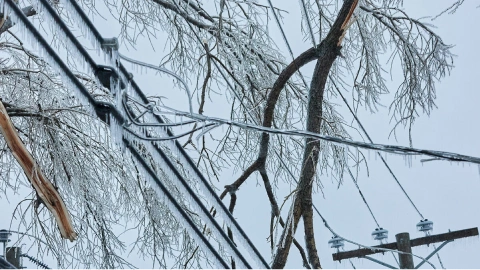
Over time, branches can grow closer to power lines, while trees can weaken and become more likely to fall. The consequences can be serious, particularly during ice storms, high winds or heavy snowfall.
Risks to safety and grid reliability
A branch that touches a power line, even briefly, can cause sparks or start a fire.
If it causes a wire to fall to the ground, someone could suffer an electric shock or be electrocuted. These risks affect both the public and the crews who work on the power system.
Branches can also cause outages and damage to the grid.
Keeping trees and power lines safely apart
Most vegetation‑related issues can be avoided by simply keeping trees, shrubs and other plants clear of power lines. Rather than waiting for a problem to arise, crews carry out preventive maintenance to reduce the risk of contact between trees and power lines.
There are several benefits to taking this approach:
- More reliable service
- Better planned, more cost‑effective interventions
- Greater safety for the public and crews
- A power grid that stays in better condition longer
A tailored approach
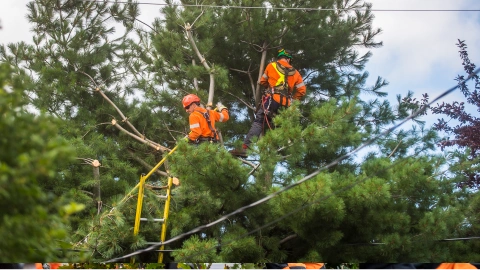
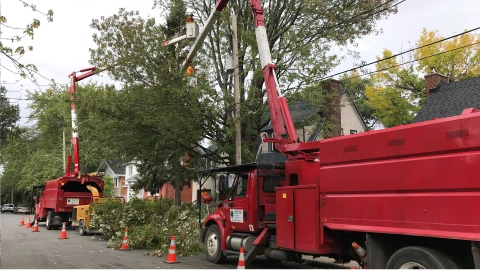
Vegetation control work is carried out by professional arborists authorized by Hydro‑Québec. The approach is tailored to the surrounding environment and level of risk posed by nearby vegetation. The goal is to preserve vegetation that’s compatible with the system while maintaining a safe clearance from power lines.
What happens to the wood?
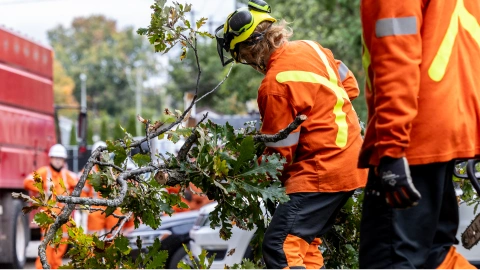
The way tree and branch debris is managed depends on the type of vegetation and the work being carried out. It may be collected or left on site.
Far from going to waste, tree and branch debris plays an important role in supporting biodiversity. As they decompose, they enrich the soil with organic matter and can even provide a habitat for wildlife.
You are responsible for the trees on your property
Hydro‑Québec performs regular vegetation control to clear medium‑voltage lines in its distribution system. However, you are responsible for maintaining the trees on your property. As such, you are also liable for any damage they may cause.
Reporting problematic trees or branches helps us better understand the state of the grid and plan our work. However, this does not shift the responsibility to Hydro‑Québec.
If you would like work to be carried out without waiting for regular vegetation control or if the situation poses a risk, you must hire a certified arborist authorized by Hydro‑Québec . These companies have personnel that is qualified to work near power lines.